






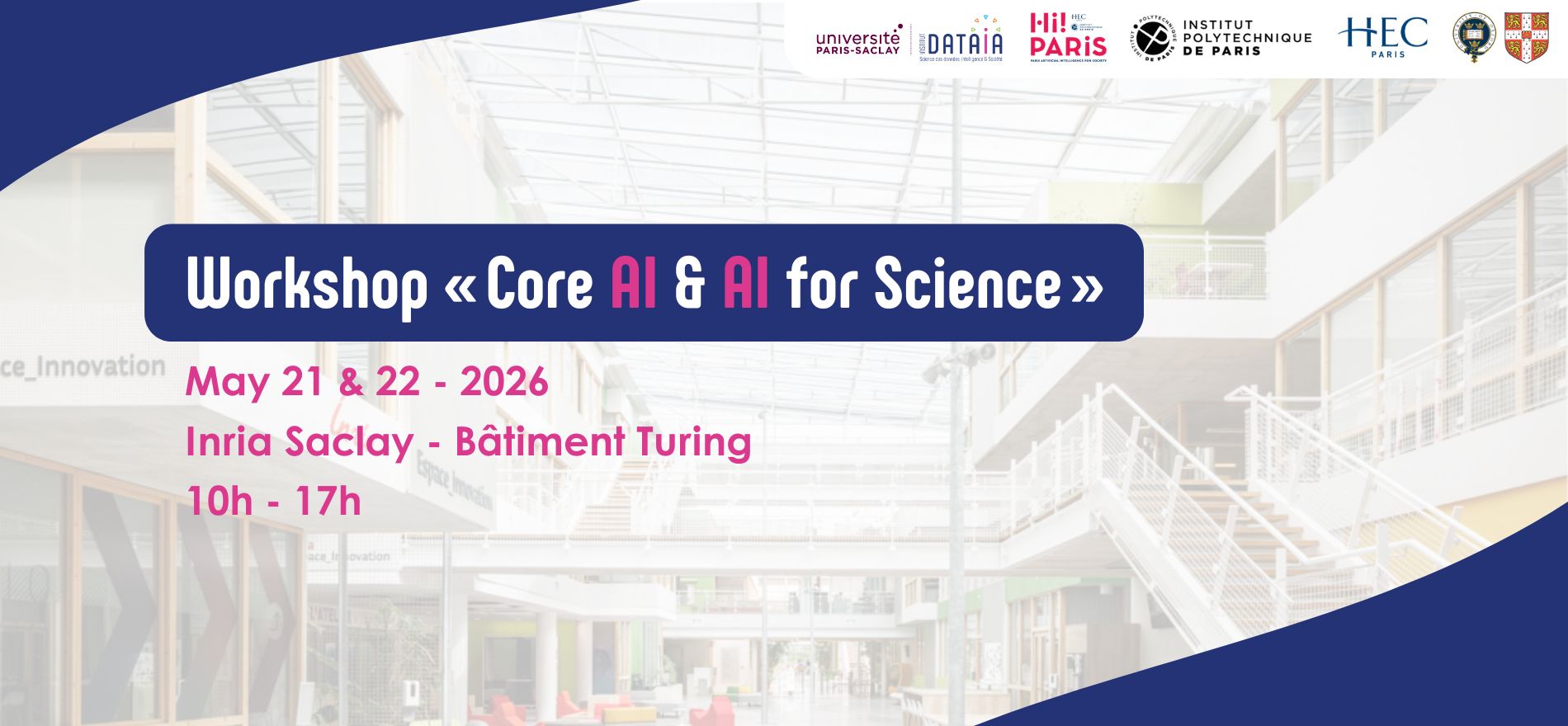
The “AI for Science” Workshop is part of a broader academic collaboration linking University of Oxford, University of Cambridge, Université Paris-Saclay, and Institut Polytechnique de Paris.
It is a two-day event dedicated to exploring how artificial intelligence is transforming scientific research across disciplines.
Designed as an interactive and collaborative forum, the workshop features a series of 40-minute talks delivered by researchers, alongside opportunities for participants to present their own work. The format encourages active engagement, discussion, and the emergence of new collaborations within a highly interdisciplinary environment.
Poster Sessions
Poster sessions are a central component of the workshop, offering participants, the opportunity to showcase their scientific posters and to engage in direct discussion with peers and more advanced researcher.
A dedicated space will be available for poster displays, allowing for continuous visibility throughout the event. Posters will be presented during the lunch sessions, fostering informal discussions and networking.
Participants wishing to present a poster will be able to indicate this during registration. In the event of a high number of submissions, a selection process will be carried out by a scientific committee. All presenters are required to print and bring their posters on-site.
Programme
The detailed programme of the Workshop “AI for Science” will be published shortly.
Confirmed speaker :
-
(Oxford).
Thomas Nichols is the Professor of Neuroimaging Statistics at the University of Oxford Big Data Institute. He is a statistician with a solitary focus on modelling and inference Bio : methods for brain imaging research. He has both industrial and academic experience and a diverse training including computer science, cognitive neuroscience and statistics. He was the Director Modelling and Genetics at GlaxoSmithKline's Clinical Imaging Centre, London, and has been at Oxford since 2017. The focus of his work is developing modelling and inference methods for brain image data, specifically Magnetic Resonance Imaging (MRI) and functional MRI. His current work includes methodology for population scale neuroimaging data, longitudinal studies and neuroimaging genetics.
-
(Oxford).
Bartlomiej (Bartek) Papiez is Group Lead for Medical Image Understanding and Machine Learning at the Big Data Institute, Associate Prof at Nuffield Department of Population Health, University of Oxford, and an Official Fellow in AI/ML at Reuben College. His research spans both the theoretical foundations of AI/ML, including data fusion, explainability, and computational fairness, and applied machine learning for longitudinal disease monitoring using imaging, patient records, and natural language processing. He also works on identifying therapeutic targets through the integration of imaging and genetic data. His current application areas include cardiovascular disease, arthritis and rheumatic diseases, and cancer.
-
Philip Stier - (Oxford).
Philip Stier is a Professor of Atmospheric Physics in the Department of Physics, where he leads the Climate Processes Group, and a Fellow of Reuben College. He also serves as Director of Intelligent Earth—Oxford’s UKRI AI Centre for Doctoral Training in AI for the Environment—and is a member of the steering group of the Oxford Climate Research Network. His research focuses on physical climate processes in the context of anthropogenic perturbations to the Earth system, which are the underlying cause of climate change and air pollution. His main areas of interest include cloud and aerosol physics, their interactions, and their role in the climate system. Within the Climate Processes Group, he and his team combine complex numerical models with Earth observations and AI/machine learning to advance theoretical understanding and improve the predictability of the climate system.
-
Antonio Silveti-Falls - (Institut DataIA - Université Paris-Saclay)
Antonio (Tony) Silveti-Falls is an associate professor (maître de conférences) at CentraleSupélec in the south of Paris, where he is a member of the Centre pour la Vision Numérique laboratory and the INRIA team OPIS. After receiving his PhD in mathematics from Université de Caen Normandie in 2021, where he was supervised by Jalal Fadili and Gabriel Peyré, he completed a postdoc at Toulouse School of Economics with Jérôme Bolte and Edouard Pauwels. His research continues to focus on {nonsmooth, stochastic, noneuclidean} optimization, especially conditional gradient methods (Frank-Wolfe) and conservative calculus (path differentiable functions) applied to deep learning. His work on the generalized conditional gradient method won the best paper award at SPARS 2019.
-
Stergios Christodoulidis - (Institut DataIA - Université Paris-Saclay)
-
Pietro Gori - (Hi! PARIS, Institut Polytechnique de Paris)
Pietro Gori is Professeur (PhD,HDR) in Artificial Intelligence and Medical Imaging at Télécom Paris (IPParis) in the IMAGES group. He did his PhD with Inria at the ARAMIS Lab in Paris and then a post-doc at Neurospin (CEA). Previous to that, he obtained a MSc in Mathematical Modelling and Computation from the DTU in Copenhagen and a MSc in Biomedical Engineering from the University of Padova. He participated to the development of the open source software suite deformetrica for statistical shape analysis and of the software platform Clinica for clinical neuroimaging studies. His research interests lie primarily in the fields of machine learning, AI, representation learning, medical imaging and computational anatomy. He has more than 60 publications in international peer-reviewed journals or conferences, 2 patents and had/has the pleasure to work with more than 25 PhD students and post-docs. He is also the co-founder of the Start-Up Replico.
-
Maxime Di Folco - (...)
Maxime Di Folco is an Assistant Professor in Artificial Intelligence for Medical Imaging within the IMAGES group. He completed his PhD at INSA Lyon within the CREATIS laboratory, followed by a postdoctoral fellowship under the supervision of Julia Schnabel at Helmholtz Munich and the Technical University of Munich. Prior to that, he obtained a Master of Engineering in Numerical Sciences from CPE Lyon and an MSc in Image Development and 3D Technologies from Université de Lyon. His research focuses on representation learning and multimodal approaches for trustworthy decision-making in medical imaging and healthcare AI.
-
Sibo Cheng - (Hi! PARIS, Institut Polytechnique de Paris)
Sibo Cheng is currently a Junior Professor at CEREA, ENPC, Institut Polytechnique de Paris in France and an Honorary Research Fellow at the Department of Computing at Imperial College London. His work focuses on machine learning for dynamical systems, reduced-order models, and inverse modeling (parameter calibration and data assimilation) for environmental science and physics, with a wide range of applications including wildfire and air pollution. He completed his Ph.D. at LISN, University Paris-Saclay, France, in 2020. From 2020 to 2024, he was a Research Associate at the Data Science Institute of Imperial College London. His current research is supported by ANR, PEPR, and Hi!Paris.
-
Judith Abécassis - (Inria, IPP, Hi! PARIS)
Judith Abécassis is a research scientist (ISFP) in the Soda team at Inria Saclay, where she bridges statistical methods in causal inference with medical applications to deliver actionable insights that enhance patient care. Collaborating closely with medical experts, she analyzes real -world observational data from the AP-HP Clinical Data Warehouse - focusing on diabetes, inflammatory diseases, and strokes - as well as administrative claims data. Her work aims to translate complex data into evidence-based recommendations for clinical decision-making. She holds a PhD in Bioinformatics from the Center for Computational Biology at Mines ParisTech and the RT2 Lab (Tumor Residue and Treatment Response) at Institut Curie, where she specialized in high-throughput sequencing data analysis from cancer genomes.
-
Bertrand Thirion - (Université Paris Saclay, Institut DataIA)
Bertrand Thirion is researcher in the [Mind team](https://team.inria.fr/mind), part of INRIA research institute, Saclay, France, that develops statistics and machine learning techniques for brain imaging. He contributes both algorithms and software, with a special focus on functional neuroimaging applications. He is involved in the Neurospin, CEA neuroimaging center, one of the leading high-field MRI for brain imaging places. From 2018 to 2021, Bertrand Thirion has been the head of the DATAIA Institute that federates research on AI, data science and their societal impact in Paris-Saclay University. In 2020, he has recently been appointed as member of the expert committee in charge of advising the government during the Covid-19 pandemic.
From 2021 to 2025, he has become the Head of science (délégué scientifique) of the Inria Saclay research center. Bertrand Thirion has been the PI of the Karaib AI Chair of the Individual Brain Charting project. He received the Académie des sciences software prize in 2020 for hist contribution to the sciki-learn software. In 2025 he co-founded and became CSO of the Karavela startup, that creates an AI model to decode brain activity from fast functional MRI sequences. -
Cyril Furtlehner - (Inria / UPS — LISN)
Cyril Furtlehner is an Inria research scientist based at the Inria-Saclay research center. With an original background in theoretical physics,his present research lies at the intersection between statistical physics and machine learning, with a focus on probabilistic inference, stochastic processes, energy-based models and more recently physics informed machine learning. He has applied these ideas to problems such as traffic modeling and forecasting, the theoretical analysis of learning algorithms leading in particular to efficient restricted Boltzmann machine training methods. More broadly, his work explores how methods from statistical physics can be used to understand and design machine-learning systems.
-
Sean Holden - (University of Cambridge) - (Inria, IPP, Hi! PARIS)
Sean Holden is University Associate Professor in the Department of Computer Science and Technology, and Director of Studies in Computing at Trinity College, Cambridge. His research interests are in the application of machine learning to automated theorem proving, where he has pioneered methods for problems such as learning in first-order proof search, and more widely in artificial intelligence for mathematics. Prior to this he published widely on the theory and applications of machine learning across areas including computational learning theory, drug design, Bayesian inference and organelle proteomics
-
Florence Tupin - (IPP — Télécom Paris)
Florence Tupin is currently a Professor of image and signal processing at Telecom Paris, where she is also head of the Image, Data, and Signal Department. Her research focuses on image processing and analysis, particularly for remote sensing and synthetic aperture radar imaging applications, and Earth observation.
She has been a member of several international and national technical conference committees since 2003. She has been co-chair of the GRETSI Technical Program Committee since 2024 and IEEE GRSS (Geoscience and Remote Sensing Society) Distinguished Lecturer since 2025. She has received several awards, including the IEEE GRSS Transactions Prize Paper Award in 2016, the IEEE GRSS Symposium Prize Paper Award in 2022 and the IEEE GRSS Letters Prize Paper Award in 2026 for her work on speckle filtering. -
Adriano Gualandi - (AI4ER, University of Cambridge (UK)
Adriano is an Assistant Professor in Geophysics at the Department of Earth Sciences and an Official Fellow of Clare Hall at the University of Cambridge (UK). He also serves as Director of the Artificial Intelligence for the study of Environmental Risks (AI4ER) UKRI Centre for Doctoral Training. His research mainly focuses on the study of nonlinear dynamical systems, friction, earthquakes and geodesy. He uses satellite and remote sensing data as well as local networks data to better understand current surface motions and the seismic cycle. He employs data analysis techniques ranging from classical statistical approaches to more modern machine learning tools to extract the relevant tectonic information out of the available observations.
Thursday 21th :
-
9h30 - 10h : welcome cofe
-
10h - 10h30 : Opening - Institut DataIA
-
Session one : AI for Health — Brain, Representation & Clinical Imaging
-
10h30 - 11h15 : Talk session - Tom Nichols (Oxford — Big Data Institute)
-
11h15 - 12h : Talk session- Stergios Christodoulidis (UPS — Institut DataIA) - Towards computational biomarker discovery in the context of spatial precision oncology
Cancer is the second leading cause of death worldwide, adding a substantial burden to both patients and healthcare systems alike. Precision oncology aims to identify targetable biomarkers for each patient, enabling personalized treatments and informing drug development efforts. The spatial structure and interactions of the cell population at the tumor microenvironment can provide valuable insights for precision oncology. In this talk, I will showcase the latest research efforts of our team in the context of spatial precision oncology, presenting several examples that provide solid grounds for computational biomarker discovery, spanning methodological contributions in representation learning for digital pathology to a novel paired dataset combining digital pathology slides with spatial transcriptomics.
-
12h - 12h15 : Break.
-
12h15-13h : Talk session - Judith Abécassis ((Inria, IPP, Hi! PARIS)) - Predicting care trajectories in the French National Health Data System using AI foundation models
The French National Health Data System (SNDS) is a rich but underexploited resource, due to the complexity and scale of its data. We structured exhaustive SNDS records for 2018–2022 covering more than 70 million beneficiaries and 28 billion health events, into a harmonized event-oriented format, and trained transformer-based foundation models on this data. We evaluated these models on 194 prediction tasks targeting first hospitalization for a wide range of diagnoses, comparing against expert-derived feature sets from the SNDS. AI models outperformed expert-derived baselines in most tasks, including priority public health conditions such as type 2 diabetes, heart failure, chronic kidney disease, and endometriosis. These results demonstrate that generic, large-scale AI processing of the SNDS is feasible and effective, opening new avenues for simplifying and improving public health research based on administrative health data.
-
--
-
13h - 14h15 : Lunch (Poster Sessions)
--
-
Session two : AI for Health — Imaging & Disease Modelling
-
14h15 - 15h : Talk session- Bartek Papiez (Oxford — Big Data Institute) - From Integrating Language and Medical Imaging: From Prediction to Explanation and Deception
-
15h - 15h45 : Talk session - Pietro Gori - (Hi! PARIS, IPP — Télécom Paris) - Multi-modal contrastive learning
Contrastive Learning (CL) is a paradigm for self-supervised representation learning whose goal is to estimate a parametric mapping function that maps positive samples (i.e., semantically similar samples) close to each other in the representation space, while mapping negative samples (i.e., semantically dissimilar samples) far apart. CL has been successfully used to train several recent uni-modal and multi-modal foundation models for both natural and medical imaging data.
In this talk, we will present recent work from our team on the multi-modal integration of clinical (tabular) and imaging data within a contrastive learning framework. In particular, we will discuss the integration of a small number of clinical variables as prior knowledge using kernel theory, as well as methods for incorporating large-scale tabular data using tabular encoders in a manner that is robust to missing values and reduces the number of false negatives, one of the main drawbacks of contrastive learning. -
15h45 - 16h : Break.
-
16h-16h45 : Talk session - Bertrand Thirion - (Université Paris Saclay, Institut DataIA) - Interpretable ML models for health data
-
17h : Cocktail (Poster Sessions)
-
Friday 22th :
-
9h30h - 10h : Accueil café.
Session three : AI for Earth & Physical Sciences
-
10h - 10h45 : Talk session- Philip Stier (Oxford — Atmospheric Physics)
-
10h45 - 11h30 : Talk session- Sibo Cheng (IPP, Hi! Paris — ENPC) - Data assimilation and machine learning for sparse observational data: Applications in atmospheric and wildfire modelling
Reconstructing spatiotemporal systems from sparse observations remains a long-standing challenge in several domains, including geoscience, atmospheric science, and fluid dynamics. While various data assimilation (DA) and machine learning (ML) methods have shown potential, they still face significant challenges, including the computational burden of conventional DA algorithms (especially for multivariate, high-dimensional systems and error covariance specification), difficulties arising from sparse and movable sensor placement that make deterministic ML models cumbersome, and the ill-defined nature of sparse reconstruction. I will present our recent work addressing these issues, in particular the development of latent DA algorithms to reduce the computational burden of variational DA methods. These algorithms show strong potential for efficiently assimilating sparse observations within a reduced-order latent space constructed by neural networks. They are supported by our TorchDA library, which enables GPU implementation of mainstream data assimilation methods and supports non-explicit state–observation transformation functions when these can be learned by a neural network. Examples will be discussed in air quality and wildfire modelling, both enable real-time prediction updates via online observation data.
-
11h30-11h45 : Break.
-
11h45 - 12H : Adriano Gualandi - (AI4ER, University of Cambridge (UK).
-
12h-12h45 : Talk session- Cyril Furtlehner (Inria / UPS — LISN) - Learning high precision PINNs with natural gradient and applications to singular solution discovery
In this talk we will introduce physics informed neural networks (PINNs) which are neural networks designed to solve PDEs. We will discuss some of their specificity related to the low-dimensionality of the input data and a strong spectral bias issue which requires to address separately optimization and learning errors. The analysis of the geometric structure of the NN tangent space will
lead us to propose an efficient natural gradient optimization approach to these problem and some understanding of the crucial role played by some regularization cutoff parameter. As will be discussed the
precision reached opens the possibility to identify anomalous exponents in scaling solutions of non-linear PDEs.--
-
12h45 - 13h45 : Lunch (Poster Sessions)
--
Session four : AI Methods & Foundations
-
13h45 - 14h30 : Talk session- Antonio Silveti-Falls (UPS — Institut DataIA)
-
14h30 - 15h15 : Talk session- Sean Holden (University of Cambridge)
-
15h15 - 15h30 : Break.
-
15h30 - 16h15 : Talk session- Florence Tupin (IPP — Télécom Paris) - Deep learning for radar image processing
Radar satellite images are valuable sources of information for Earth observation. They have the advantage of being acquired regardless of cloud cover and provide unique insights into the elevation or movement of features on the Earth's surface. However, the acquisition process through coherent imaging leads to significant variability in measurements, making their analysis challenging. In this presentation, we will explore how deep learning, combined with acquisition physics, enables significant improvements in these images and contributes to numerous applications.
-
16h15 - 16h45 : closure talk.
Practical Information :
- Dates: Thursday, May 21 and Friday, May 22
- Time: From 10:00 am to 5:00 pm (to be confirmed)
- Location: Turing Building (to be confirmed)
- Registration is free but mandatory!
You can register now via the online form !