






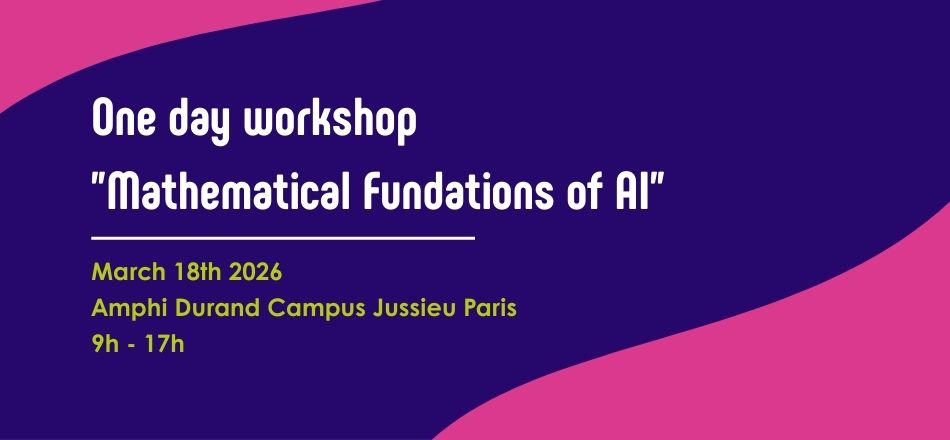
One day workshop "Mathematical Fundations of AI"
On March 18th 2026, take part in a one day workshop with 8 interesting talk over "Mathematical Fundations of AI" organised by CAUSALI-T-AI.
A joint event between the RT Uncertainty Quantification, the CAUSALITAI project and the AI clusters MIAI, SCAI and DATAIA !
Registration is free but mandatory before March 12, 2026 : here
Speakers & Schedule:
9:00 - 10:00 : Irène Balleli - Centre Inria d'Université Côte d'Azur, équipe/projet EPIONE
Title: Voting, ensembling, and population-level causal discovery: what and how an expert audience can contribute?
Discovering reliable cause-and-effect relationships from real-world data is an extremely complex and still open challenge. Existing Causal Discovery (CD) algorithms, even when proven theoretically identifiable, rely on strict assumptions that are rarely met in complex real-world scenarios, such as the functional form of the causal relationships, the data distribution family, and the causal sufficiency. As a result, the reliability of these algorithms can significantly drop, compromising the interpretability of the results and the trustworthiness of downstream decision-making. What if, instead of relying on a single CD expert and its partial understanding of the true underlying causal mechanism, we consulted an audience of experts? In this talk, I will introduce and discuss three main strategies for achieving expert consensus on causal discovery: voting, ensembling, and population-based analysis. I will highlight the level of additional information that each of the considered strategies can provide compared to a traditional single-expert-based approach, and outline how such strategies can be implemented effectively, starting with the communication bottleneck between experts. I will present some results from controlled simulation studies and a real-case application on lung cancer genetic disruptions, which will demonstrate the effectiveness of an expert audience in reinforcing the strengths of each expert while mitigating their uncertainties.
10:00 - 10:30 : Cofee Break
10:30 - 11:00 : Margaux Zaffran - Institut Mathématiques d'Orsay, équipe/projet Inria Celeste
Title : Momentum Smooths the Path to Gradient Equilibrium
Online gradient descent has recently been shown to satisfy gradient equilibrium for a broad class of loss functions, including quantile loss and squared loss. This means that the average of the gradients of the losses along the sequence of estimates converges to zero, a property that allows for quantile calibration and debiasing of predictions, among other useful properties of statistical flavor. A shortcoming of online gradient descent when optimized for gradient equilibrium is that the sequence of estimates is jagged, leading to volatile paths. In this work, we propose generalized momentum method, in the form of weighting of past gradients, as a broader algorithmic class with guarantees to smoothly postprocess (e.g., calibrate or debias) predictions from black-box algorithms, yielding estimates that are more meaningful in practice. We prove it achieves gradient equilibrium at the same convergence rates and under similar sets of assumptions as plain online gradient descent, all the while producing smoother paths that preserve the original signal amplitude. Of particular importance are the consequences for sequential decision-making, where more stable paths translate to less variability in statistical applications. These theoretical insights are corroborated by real-data experiments, showcasing the benefits of adding momentum.
11:00 - 11:30 : Agathe Fernandes Machado - UQAM, Montreal (Quebec, Canada)
Title: Causal Mediation Analysis via Sequential Transport to Assess Counterfactual Fairness
Algorithmic fairness refers to a set of principles and techniques aimed at ensuring that the decisions produced by an algorithm are fair and non-discriminatory toward all users, regardless of personal characteristics such as gender, ethnicity, or other so-called sensitive attributes. Its assessment can be conducted at the individual level by focusing on a specific individual from a minority group and asking counterfactual questions such as: “What would this woman’s salary be if she were a man?” To evaluate the unfairness of a machine learning model, we adopt the notion of Counterfactual Fairness proposed by Kusner et al. (2017). We introduce a distributional framework for causal mediation analysis based on optimal transport (OT) and its sequential extension along a mediator Directed Acyclic Graph (DAG), in which the sensitive attribute corresponds to the treatment variable. Rather than relying on cross-world structural counterfactuals, we construct mediator counterfactuals in a mutatis mutandis sense: mediators are modified only as necessary to align an individual with the distribution under the alternative treatment, while respecting the causal dependencies among mediators. Sequential transport (ST) builds these counterfactuals by applying univariate or conditional OT maps following a topological order of the mediator DAG, and naturally extends to categorical mediators through adapted transport techniques on the probability simplex. Finally, we discuss how uncertainty in the causal graph propagates to the transport maps and may lead to unethical fairwashing.
11:30 - 12:30 : Aurore Lomet - CEA Saclay LIAD
Title : Scaling Causal AI for Seismic FEM Simulation
This presentation addresses the scalability of a causal discovery approach for multivariate time series in the context of seismic data assimilation. The proposed approach relies on kernel-based conditional independence tests, in particular the Hilbert–Schmidt Independence Criterion (HSIC). While dependence measures such as HSIC are commonly used in uncertainty quantification to quantify input–output influence, they are used here for independence testing to infer directed temporal graphs from sensor data while limiting distributional assumptions.
Since kernel-based methods require the construction of Gram matrices that limit scalability for long time series, a Random Fourier Features approximation is employed to reduce computational cost. The inference procedure is also ported to GPU to support high-performance execution.
12:30 - 13:30 : Lunch Break
13:30 - 14:30 : Qingyuan Zhao - University of Cambridge
Title: A counterfactual perspective of heritability, explainability, and ANOVA
Existing tools for explaining complex models and systems are associational rather than causal and do not provide mechanistic understanding. Motivated by the concept of genetic heritability in twin studies, this talk will introduce a new notion called counterfactual explainability for causal attribution. This can be viewed as an extension of global sensitivity analysis (functional ANOVA and Sobol’s indices), which assumes independent explanatory variables, to dependent explanatory variables whose causal relationship can be described by a directed acyclic graph. The new notion will be illustrated using several artificial and real-world examples. This talk is based on joint works with Zijun Gao, Haochen Lei, and Hongyuan Cao.
14:30 - 15:00 : Preben Ness - Simula Research Laboratory (Oslo, Norway)
(More informations coming soon)
15:00 - 15:30 : Zhe Li - Université de Bordeaux
(More informations coming soon)
15:30 - 16:00 : Cofee Break
16:00 - 17:00 : Victor Elvira University of Edinburgh
Title: Graph-structured state-space models beyond linear dynamics
Modelling and inference in multivariate time series are central problems in statistics, signal processing, and machine learning. A recurring challenge is to understand and represent directed relationships between components of a dynamical system, either at the level of observed signals or latent states. Graphical modeling combined with sparsity constraints provides a natural language to encode such structure, limit parameter growth, and improve interpretability. In this talk, we adopt the perspective that state-space models can be interpreted as graph-structured dynamical systems, where edges encode dependencies in the latent evolution. We first briefly revisit the linear-Gaussian setting, where transition operators and noise covariances induce sparse directed graphs. We then focus on nonlinear extensions, showing how this graph-based view can be lifted beyond linear dynamics using differentiable probabilistic models. In particular, we introduce GraphGrad, a framework that enables learning graph-structured latent dynamics in nonlinear state-space models via gradient-based inference. This approach preserves interpretability while extending graph-based system identification to settings with nonlinear dynamics and complex observation models.