







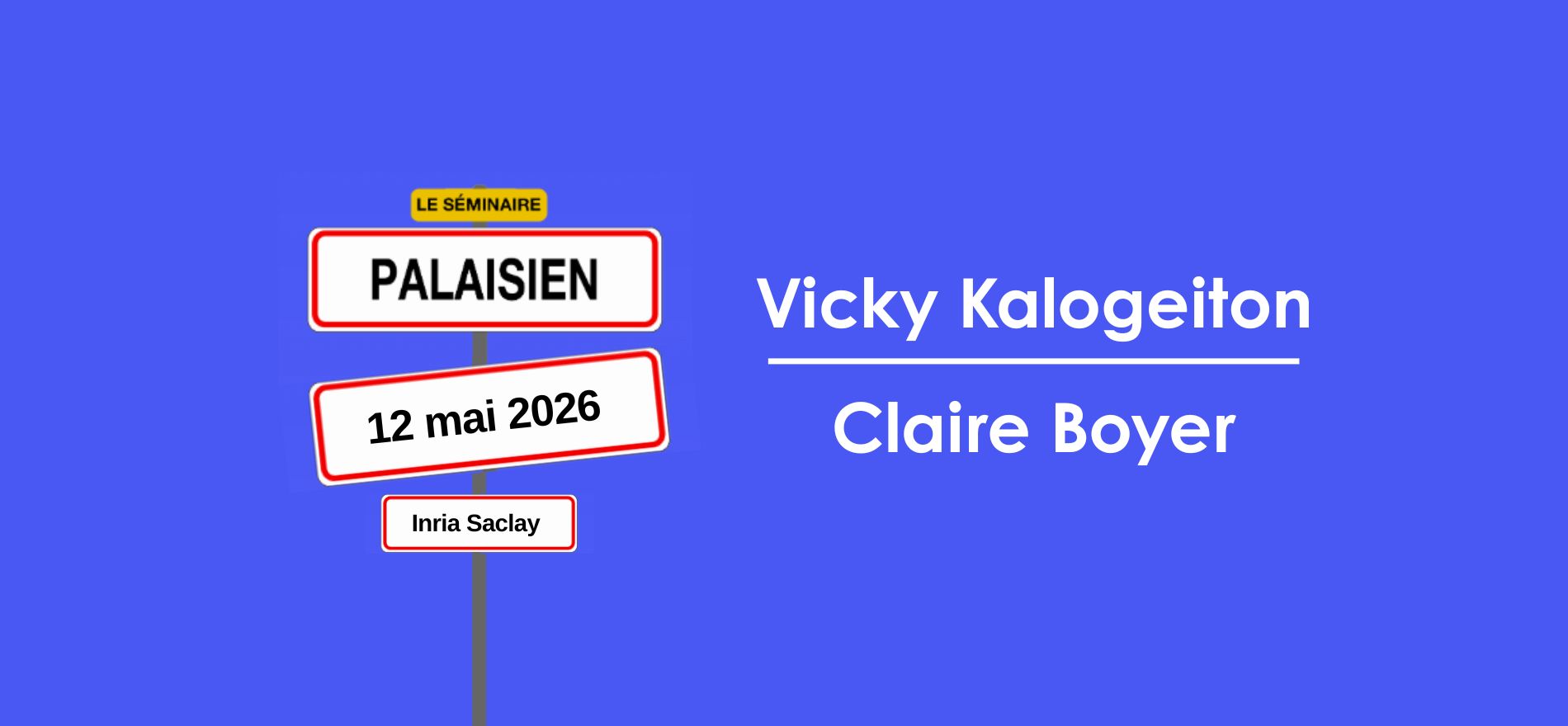
Chaque session du séminaire est divisée en deux présentations scientifiques de 40 minutes chacune : 30 minutes d’exposé et 10 minutes de questions. Vicky Kalogeiton & Claire Boyer animeront la session de mai 2026 !
-
Vicky Kalogeiton sur "Scale is religion?"
Intelligent robots do not just respond to commands; they imagine what you meant, what you wanted, what you believed. And they do this while learning from very little, and running on a chip in your living room.
In this talk, I will present recent advances in generative modeling that aim to equip embodied agents with efficient models that can run faster, with fewer data, and more efficient models and imagine possible futures under uncertainty.
-
Claire Boyer sur "How Learning Rates & Latent Spaces Shape Diffusion Generative Models"
This talk explores two surprising mechanisms that shape the behavior of diffusion-based generative models. First, we uncover an implicit regularization effect in denoising score matching: large learning rates prevent models from overfitting the training data, mitigating memorization without explicit constraints. Second, we show that in Latent Diffusion Models, running the diffusion too long can worsen sample quality, a phenomenon rooted not in numerical instability, but in the dimensionality reduction of the latent space. We derive conditions linking optimal stopping time to latent dimension, revealing it as a key hyperparameter for generation quality. Together, these findings highlight how early (diffusion) stopping and optimization dynamics jointly govern generalization in modern diffusion models.
Détails :
- Date : 12 mai 2026
- Horaire : 12h
- Lieux : Inria Saclay - Amphi Sophie Germain